Tertullian, in Against Praxeas, clearly articulated a belief in the Trinity, emphasizing the distinct persons of the Father, the Son, and the Holy Spirit, while affirming their unity as "One Only God." He describes the Holy Spirit as "the Third Person in the Godhead and the Third Rank of Divine Majesty," who "reveals the unity of God’s monarchy, while also explaining the divine plan to all who hear and accept the words of the new prophecy." The Holy Spirit is also identified as "“the Guide into all truth,” as found in the Father, the Son, and the Holy Spirit, according to the mystery of Christ’s teaching."
Tertullian argues that this understanding of God as Father, Son, and Spirit is a fundamental aspect of the Christian faith, distinguishing it from the "Jewish faith, whose core is this: to believe in One God while refusing to acknowledge the Son alongside Him, and after the Son, the Spirit." He asserts that God chose to renew His covenant with humanity "so that His Unity might be understood in a new way—through the Son and the Spirit—so that God could now be openly known in His true Names and Persons, who in ancient times was not clearly understood, though revealed through the Son and the Spirit."
Furthermore, Tertullian condemns those who deny the distinctness of the persons, stating, "away with those “Antichrists who deny the Father and the Son.” They deny the Father when they say He is the same as the Son." He presents this Trinitarian "rule of faith" as something "handed down to us from the very beginning of the gospel," predating later heresies like that of Praxeas. He also refers to the Holy Spirit as "the Paraclete, who sanctifies the faith of those who believe in the Father, the Son, and the Holy Spirit."
Works Cited in This Issue
-
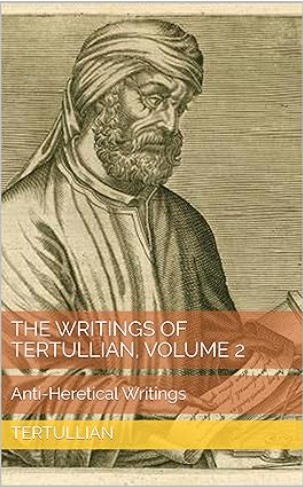
Writings of Tertullian, Volume Two: Anti-Heretical Writings
This volume gathers Tertullian’s major anti-heretical works from the Ante-Nicene Fathers, presented in clear, contemporary English for today’s reader. These writings arise from a period when Christian doctrine had not yet been formally codified and the church was forced to define its faith through sustained conflict with rival teachers operating from within its own ranks. Modernized for today’s reader, these writings preserve Tertullian’s polemical edge while removing the barriers of archaic English. Together they reveal a Christianity learning to define itself from within, under the pressure of doctrinal fracture, philosophical challenge, and the ever-present cost of public faith.
This answer was generated on 2026-09-16 using a retrieval-augmented generation (RAG) system built on Appian Way Press's own translations and revisions of early Christian writings, with the gemini-2.5-flash language model producing the final answer text from the retrieved passages.