What did Gregory Nazianzen think of the divinity of the Son?
Gregory Nazianzen held that the Son is fully divine and consubstantial with the Father, a position he defended against heretics such as Eunomius. Eunomius, who was a student of Aëtius, pushed the Arian heresy to its extreme, arguing for the absolute "unlikeness" of the Father and the Son. Eunomius claimed that an eternal generation was impossible and that the Son's generation must have had a beginning, thereby denying the Son's full Godhead.
In his Select Letters and Orations of Gregory Nazianzen, particularly in the Introduction to the “Theological” Orations, Gregory Nazianzen's position on the Son is summarized as follows: "The Son is completely of the same Substance as the Father and shares all the attributes of Godhead with Him." While the Son is a distinct Person, identified by the fact that "He is begotten of the Father," Gregory Nazianzen cautioned against understanding the term "Begotten" in a way that would compare it to created things, emphasizing that it "is entirely beyond time, space, and human understanding."
Gregory Nazianzen's primary objective in his public speeches was to uphold the Nicene Faith of the Trinity. This doctrine asserts that there is only one substance or essence in God, making God absolutely one, yet within this undivided unity, there are three distinct persons: Father, Son, and Holy Spirit. These persons are "distinguished from one another by special characteristics (ἰδιότητες) or personal properties." He actively confronted those who "denied either the consubstantiality of the Son with the Father or the full Godhead and personality of the Holy Spirit."
Works Cited in This Issue
-
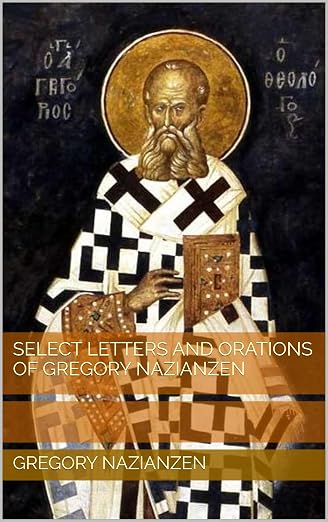
Select Letters and Orations of Gregory Nazianzen
Select Letters and Orations of Gregory Nazianzen offers an insightful glimpse into the theological, ecclesiastical, and pastoral challenges facing the fourth-century Church during a time of intense doctrinal development and controversy. As one of the Cappadocian Fathers and a pivotal figure in defending Nicene Trinitarian theology, Gregory’s writings address the complexities of articulating the nature of the Father, Son, and Holy Spirit in the aftermath of the Council of Nicaea. His celebrated Five Theological Orations explore the divinity of the Son and the Spirit while emphasizing the importance of scriptural interpretation, Christian confession, and worship in shaping theology. The included letters complement these orations by revealing Gregory’s personal experiences, relationships, and leadership struggles within the broader ecclesiastical context. This modern edition, preserving the historic Nicene and Post-Nicene Fathers translation, remains an essential resource for understanding the development of early Christian doctrine and the historical Church.
This answer was generated on 2026-10-17 using a retrieval-augmented generation (RAG) system built on Appian Way Press's own translations and revisions of early Christian writings, with the gemini-2.5-flash language model producing the final answer text from the retrieved passages.