What did Augustine think of the Sermon on the Mount?
Augustine held the Sermon on the Mount in high regard, viewing it as a comprehensive guide for Christian living. In his work, De Sermone Domini in Monte Secundum Matthaeum, which is an explanation of the first part of the sermon found in Matthew chapter five, he states that for a "reader who is willing and devout, his teaching brings out rich stores of spiritual truth."
He further elaborates that anyone who considers "the sermon our Lord Jesus Christ spoke on the mountain, as we read it in the Gospel according to Matthew," will find in it "a complete guide to the Christian life" concerning "the highest moral teaching." Augustine supports this assertion by pointing to the sermon's conclusion, which makes it clear that it "contains all the commands that shape how we live." He references the Lord's words: "Therefore, whosoever heareth these words of mine, and doeth them, I will liken him unto a wise man, which built his house upon a rock: and the rain descended, and the floods came, and the winds blew, and beat upon that house; and it fell not: for it was founded upon a rock. And every one that heareth these words of mine, and doeth them not, I will liken unto a foolish man, which built his house upon the sand: and the rain descended, and the floods came, and the winds blew, and beat upon that house;".
Regarding his exegetical approach to the Sermon on the Mount, Augustine employed allegorical interpretation. For instance, in his commentary on the Sermon on the Mount, he "makes a tight comparison between the Beatitudes and the seven spiritual workings in Isa. 11:2, 3." While he "never denies the historical meaning," he was accustomed to "adding something else on top of it," even when not trying to prove a specific point.
Works Cited in This Issue
-
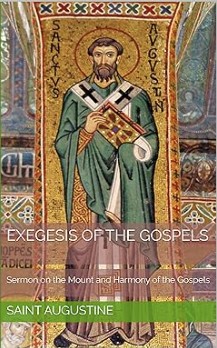
Exegesis of the Gospels: Sermon on the Mount and Harmony of the Gospels
In his commentary on the Sermon on the Mount, Augustine works methodically through Matthew 5–7, treating the text not as a collection of isolated sayings but as a coherent whole. He explores the moral vision of the sermon, the formation of Christian virtue, and the relationship between outward obedience and inward transformation. The result is a sustained reflection on the shape of the Christian life grounded in the teaching of Jesus. In The Harmony of the Gospels, Augustine turns to a different but related task. Confronted with variations among the Gospel accounts, he examines questions of order, detail, and emphasis, seeking to show how the evangelists may be read together without contradiction. Rather than erasing differences, he accounts for them, arguing that each Gospel contributes to a unified and trustworthy witness to the life of Christ.
This answer was generated on 2026-10-11 using a retrieval-augmented generation (RAG) system built on Appian Way Press's own translations and revisions of early Christian writings, with the gemini-2.5-flash language model producing the final answer text from the retrieved passages.