How does Justin Martyr describe early Christian worship, the eucharist, and baptism?
Justin Martyr provides a detailed account of early Christian worship, the eucharist, and baptism, particularly in his First Apology for Christians to Antoninus the Pious.
Regarding early Christian worship, Justin Martyr describes regular gatherings on "the day called the sun’s day," where Christians from cities and the countryside would meet in one place. During these meetings, "the memoirs of the apostles, or the writings of the prophets, are read as far as time allows." After the reading, "the leader gives a teaching and encouragement by word of mouth to imitate these good things." The congregation then stands together to offer prayers. Following the prayers, bread, wine, and water are offered. The leader "sends up prayers and thanksgivings with as much power as he has," to which the people respond by shouting "Amen," a Hebrew word meaning "so be it." The blessed elements are then distributed to each person, and deacons carry them to those who are not present. Those who are "well off and willing each give what they want according to their choice." Justin also notes that after baptism, the newly baptized is brought to the gathered "brothers" where they offer "common prayers both for ourselves and for the one enlightened, and for all others everywhere with all eagerness." After these prayers, they "greet one another with a kiss."
Concerning the eucharist, Justin Martyr explains that the blessed bread, wine, and water are distributed by deacons after the leader's thanksgiving and the people's "Amen." This food is called "the Eucharist." He states that "no one else is allowed to share in it except the one who believes that the teachings given by us are true, and who has been bathed in the bath for the forgiveness of sins and for rebirth, and who lives in the way that Christ handed down." He clarifies that "we do not receive this as common bread or common drink; but just as Jesus Christ our Savior was made flesh by the word of God, and had flesh and blood for our salvation, so also the food blessed by the word of thanksgiving from him, from which flesh and blood are fed to us by change, we have been taught to be the flesh and blood of that Jesus who was made flesh." He attributes this teaching to the apostles, who, in their "memoirs" (called the Gospels), recorded Jesus' command to take bread and, after giving thanks, to say, "Do this in remembrance of me; this is my body;" and likewise, taking the cup and giving thanks, to say, "This is my blood;" and to give these only to themselves. Justin Martyr suggests that the consecration of the eucharistic elements occurs through the commemoration of Christ’s own words of institution. He notes that two brief prayers of Thanksgiving are offered: one "for the Holy Vine of David" and another "for the broken Bread." He also mentions that "evil demons imitated" these practices, "copying the mysteries of Mithras," where "bread and a cup of water are placed in the mysteries of the initiates with certain prayers afterward."
For baptism, Justin Martyr, in his First Apology, chapter 61, describes it as preceded by instruction in Christian doctrine, a profession of faith, and a promise of repentance and holy living. He explains that "this washing is called Illumination (φωτισμός) because those who learn these things are enlightened in their understanding." He further states that the eucharist is only for those "who has been bathed in the bath for the forgiveness of sins and for rebirth."
Works Cited in This Issue
-
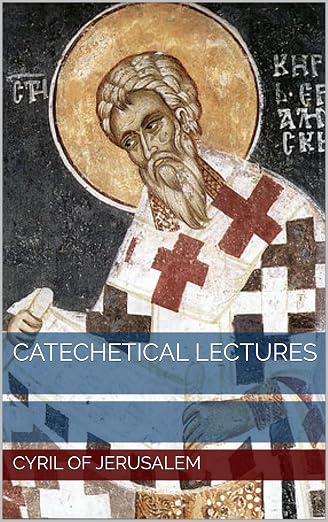
Catechetical Lectures
Cyril of Jerusalem’s Catechetical Lectures provide a comprehensive fourth-century guide to Christian doctrine, baptism, worship, and the life of the Church, originally delivered to catechumens and newly baptized believers in Jerusalem. The collection includes eighteen lectures covering core Christian teachings such as the Trinity, incarnation, resurrection, and eternal life, followed by five mystagogical lectures that explain the rites of baptism, chrism, and the Eucharist. These writings offer valuable insights into early Christian theology, liturgical practices, and the creed specific to the Jerusalem church during a formative period marked by theological controversies and the development of orthodox Trinitarian doctrine. Beyond their theological content, the lectures serve as an important historical testimony to the baptismal and Eucharistic practices of the early Church. This modern edition, revised through an AI-assisted editorial process, preserves the classic English translations along with introductions and notes, making this pivotal witness to early Christianity accessible to contemporary readers.
-
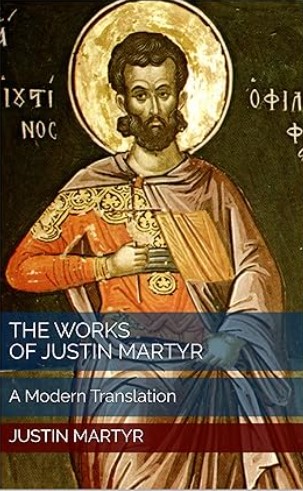
The Works of Justin Martyr: A Modern Translation
Justin Martyr (c. 100–165) was among the earliest Christian authors to engage directly and systematically with Greco-Roman philosophy, Jewish interpretation of Scripture, and Roman political authority. Writing as a philosopher-convert, Justin sought to explain and defend Christianity as the true fulfillment of reason, Scripture, and monotheistic belief. His works stand at the beginning of Christian apologetic literature and exerted lasting influence on later theology. This edition includes Discourse to the Greeks, Exhortatory Discourse to the Greeks, On Monarchy, First Apology, Second Apology, and the Dialogue with Trypho. Together, these writings address pagan critics, Jewish interlocutors, and imperial officials, offering insight into how early Christians articulated their faith in a pluralistic and often hostile environment. While modern scholarship has questioned the authorship of some shorter treatises, they are presented here as they have been historically transmitted under Justin’s name.
This answer was generated on 2026-10-18 using a retrieval-augmented generation (RAG) system built on Appian Way Press's own translations and revisions of early Christian writings, with the gemini-2.5-flash language model producing the final answer text from the retrieved passages.