How does Chrysostom use 1 Corinthians 7 in his teaching on marriage and celibacy?
John Chrysostom, in his Homilies of Saint John Chrysostom: First Corinthians, specifically HOMILY XIX, addresses 1 Corinthians 7:1, 2 by explaining Paul's guidance on marriage and celibacy. He notes that the Corinthians had inquired, "Is it right to abstain from one’s wife or not?" Chrysostom explains that Paul "does not follow a strict order but varies his approach as the situation and the urgency of the issues demand," offering "some encouragement and advice about marriage and virginity, giving his listeners a break from harsher topics."
Chrysostom interprets Paul's statement in 1 Corinthians 7:1, "It is good for a man not to have sexual relations with a woman," as describing "the best and most excellent path." However, he clarifies that if one considers "what is safe and helpful for your own weakness, then be joined in marriage," directly referencing 1 Corinthians 7:2: "But because of sexual immorality, let each man have his own wife, and let each woman have her own husband."
He emphasizes that continence, practiced "with chastity and honor," is universally required, stating that "otherwise, we cannot see God." Chrysostom also mentions that he has "already written an entire book on this subject" of virginity, where he examined "every aspect of it" with care. Therefore, in his homily on 1 Corinthians, he refers listeners to that work for a full discussion. He concludes that regardless of one's marital status—whether virgin, in a first marriage, or in a second marriage—the pursuit of continence is necessary "that we may be worthy to see Him and receive the kingdom of heaven."
Works Cited in This Issue
-
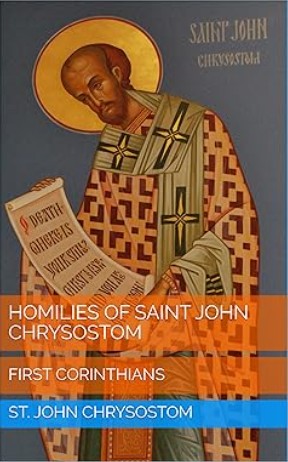
Homilies of Saint John Chrysostom: First Corinthians
Paul’s first letter to the Corinthians wrestles with issues that remain pressing today—division, pride, sexual ethics, the Lord’s Supper, and the meaning of love. Preached in the late fourth century to the Christians of Antioch, Chrysostom’s homilies offer both historical insight and enduring pastoral wisdom. His words cut through cultural distance with astonishing relevance, exposing the heart of Paul’s message to the Church in every age. This updated edition preserves the theological depth of the original English translation while presenting it in a form suitable for modern readers. It’s an essential resource for anyone who wants to hear the golden voice of the early Church expound the Apostle’s call to holiness, love, and unity.
-
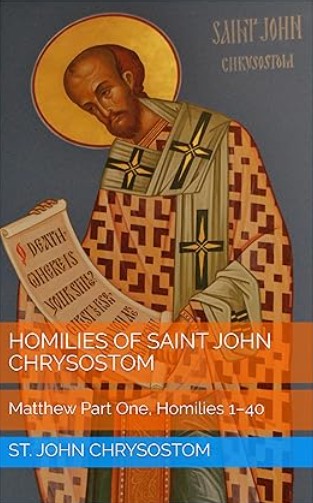
Homilies of Saint John Chrysostom: Matthew Part One, Homilies 1–40
Saint John Chrysostom (c. 349–407), the “Golden-Mouthed” preacher, delivered these homilies in Antioch, addressing real congregations with a blend of scriptural exposition and moral exhortation. In these sermons, he unfolds the opening chapters of Matthew’s Gospel, reflecting deeply on Christ’s genealogy, birth, baptism, the Sermon on the Mount, and the beginning of his ministry. This volume presents Homilies 1–40 in a freshly revised edition of the NPNF translation. The language has been carefully updated to enhance clarity while preserving accuracy and rhetorical force.
-

Homilies of Saint John Chrysostom: Philippians, Colossians, and the Thessalonian Epistles
Chrysostom’s preaching brings Paul’s letters to life with clarity, urgency, and deep spiritual insight. In these homilies on Philippians, Colossians, and First and Second Thessalonians, Saint John Chrysostom guides his congregation—and modern readers—through some of Paul’s most encouraging and practical writings.
This answer was generated on 2026-11-15 using a retrieval-augmented generation (RAG) system built on Appian Way Press's own translations and revisions of early Christian writings, with the gemini-2.5-flash language model producing the final answer text from the retrieved passages.